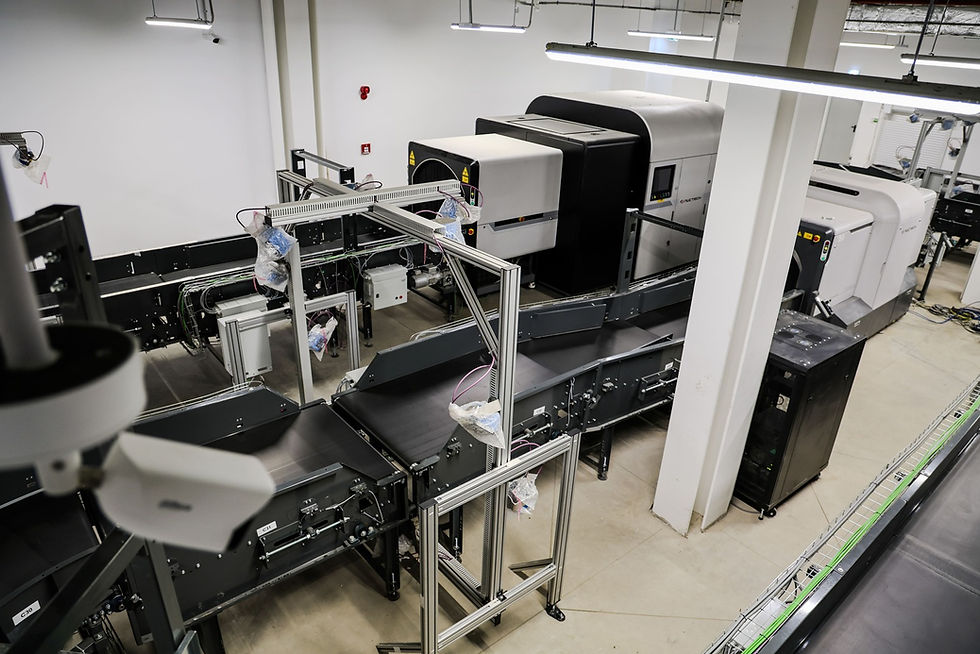
Automatic Tray Return Systems (ATRS) for Airport Security
The security checkpoint is where airport queues form. Passengers unload laptops and liquids into trays, the trays go through the X-ray, and then someone has to carry the empty trays back to the start of the line. When that last step is manual, it slows everyone down. An automatic tray return system (ATRS) removes it: trays travel back to the divest area on their own, in a continuous loop, so the lane keeps moving.
This article explains what an ATRS is, how it works, the components it's built from, and
what to look for when choosing a manufacturer.

What is an automatic tray return system?
An ATRS is a conveyor system installed at an airport security screening lane that automatically returns trays from the reclaim end, where passengers collect their belongings after the X-ray, back to the divest end, where they load them. Instead of staff shuttling stacks of trays, the system recirculates them under the counter and feeds them back to waiting passengers.
The result is a checkpoint that processes more passengers per hour with fewer staff, while giving travellers a calmer, more organised experience.
How an ATRS works
A typical ATRS forms a loop around the X-ray machine:
Divest. Passengers take trays from a powered stack and load their belongings.
Screening. Loaded trays feed into the X-ray tunnel on the conveyor.
Reclaim. Cleared trays arrive at an extended reclaim section where passengers repack.
Reject line. Trays flagged for secondary inspection are automatically diverted to a separate search position, keeping the main flow clear.
Return. Empty trays are recirculated, usually beneath the reclaim table, back to the divest area, ready to be reused.
Because the reject line pulls suspect bags aside automatically, security officers deal with them without stopping the whole lane, and cleared passengers are never held up behind an inspection.
Why airports install an ATRS
Higher throughput. A continuous tray loop and a longer reclaim zone let more passengers divest and repack in parallel, raising the number processed per hour.
Fewer staff at the lane. Trays return themselves, so officers focus on screening rather than logistics.
Better passenger experience. Orderly tray flow and a generous repack area reduce the crush at the checkpoint.
Ergonomics and safety. Powered tray stacks and automatic return cut the repetitive lifting that manual tray handling involves.
What an ATRS is made of
An ATRS is more than a conveyor. A complete system typically includes:
The tray return conveyor loop that recirculates empty trays.
A diverter or reject line that pulls flagged trays aside for secondary inspection.
Roller and belt conveyor sections feeding into and out of the X-ray.
Integration with the X-ray or screening machine, so trays move in step with the screening process.
Security trays sized for X-ray and metal-detector screening.
Operator controls, indicator signalling and scanning cameras for tray tracking and lane management.
ATRS and RTS
An ATRS is the fully automated option. A simpler return tray system (RTS) returns trays along the checkpoint without the full automated loop, and suits smaller checkpoints or tighter budgets. A good manufacturer offers both and helps match the right level of automation to the lane's throughput and space.
What to look for in an ATRS manufacturer
In-house manufacturing, so the tray return, diverter, rollers and trays are built and matched as one system rather than assembled from mismatched parts.
Integration experience with the X-ray and EDS machines already in use at the checkpoint.
Security trays supplied with the system, correctly sized for X-ray and metal-detector screening.
Robust, continuous-duty construction built for the demands of a busy checkpoint.
Who supplies automatic tray return systems for airports?
CITCOnveyors designs and manufactures automatic tray return systems in-house for airport security checkpoints, and supplies them worldwide. Each system combines the tray return loop, an automatic reject line for secondary inspection, roller and belt sections, operator controls and scanning, integration with the checkpoint's X-ray screening, and the security trays themselves. For checkpoints that don't need full automation, a simpler return tray system (RTS) is available.
Because CITCOnveyors builds the whole system in-house, the ATRS is engineered to the lane's layout and throughput rather than forced to fit an off-the-shelf footprint.
Frequently asked questions
What is an automatic tray return system?
It's a conveyor system at an airport security lane that automatically returns trays from the reclaim end back to the divest end, so the checkpoint runs faster with fewer staff.
How does an ATRS improve security throughput?
It recirculates trays automatically and provides a longer reclaim area, letting more passengers divest and repack at once, while a reject line diverts flagged bags without stopping the lane.
What's the difference between ATRS and RTS?
An ATRS is the fully automated tray-return loop; a return tray system (RTS) is a simpler solution for smaller checkpoints without full automation.
Who manufactures ATRS for airports?
CITCOnveyors manufactures automatic tray return systems in-house, including the trays, and supplies them to airport security checkpoints worldwide.