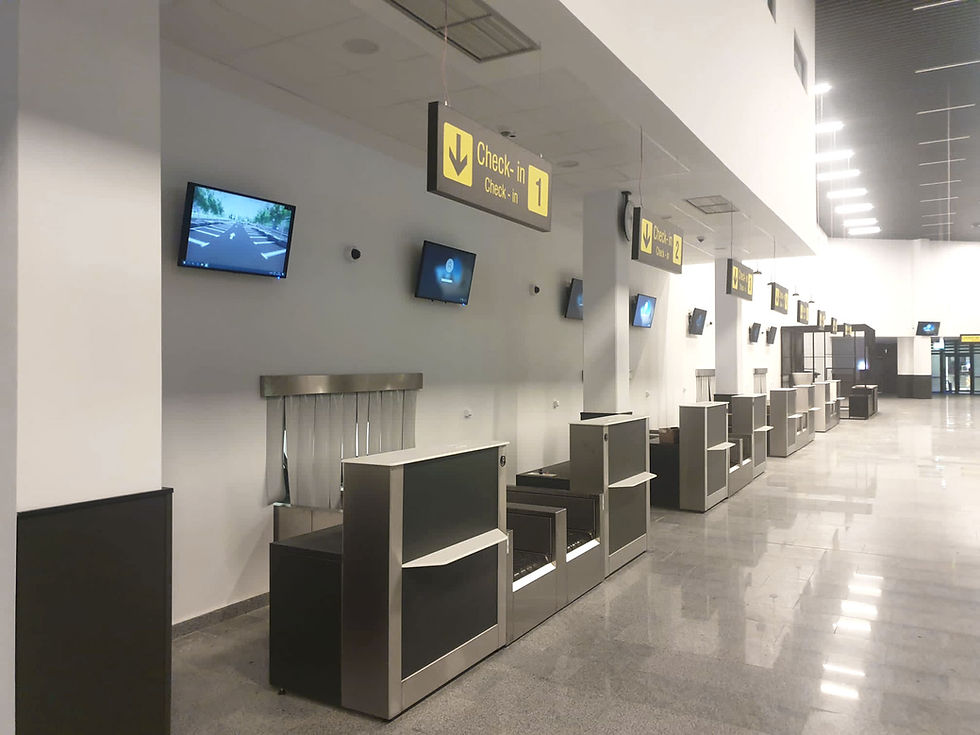
CITCOnveyors designs, manufactures and installs complete baggage handling systems for airports — from check-in conveyors through security screening integration to make-up and reclaim carousels. Every system is engineered in-house for the specific terminal, with capacities from 400 to over 1,000 bags per hour.
Our baggage handling systems include:
-
Integrated control and automation, with SCADA supervision in real time;
-
Redundant, fail-safe design — hot standby PLC architecture keeps the system running if a controller fails;
-
Integration with a wide variety of scanning and screening devices;
-
Continuous bag tracking with a unique identifier from check-in to make-up, in line with IATA Resolution 753;
-
Variable belt speed from 0.2 to 1.2 m/s, matched to the role of each conveyor section;
-
Dynamic simulation run from the design phase, before manufacturing begins.
Hold baggage screening is where most of the complexity sits. A system may run a simple manual inspection line, or a full multi-level architecture:
Level 1 — Automated decision by the screening equipment
Level 2 — Human operator, limited decision time
Level 3 — Human operator, unlimited decision time
Level 4 — Reconciliation of the bag with the passenger
Level 5 — Operator check and disposal if required
Each level requires its own conveyor types, buffering capacity and control logic. Bags cleared at a given level are routed automatically toward the make-up carousel. Bags that need further inspection are held dynamically within the conveyor network, with belt speed adjusted in real time so security operators have sufficient review time at every decision point.


Flexible layout, engineered per project
For every BHS we run a dynamic simulation from the design phase — modelling throughput, identifying critical points and testing the optimal layout before any steel is cut.
Every airport project starts from a different set of constraints: available floor space, ceiling height, column grid, the number of bags to be processed in the peak hour, and the level of security screening required. No two terminals impose the same conditions, which is why we treat layout engineering as the first step rather than an adaptation of a standard product.
From capacity sizing with purpose-built simulation software, through 3D design of the complete conveyor network, to installation and commissioning on site, the same team follows the project. We keep a high level of communication with the client at every stage, because transparency is what keeps a complex installation on schedule.
A baggage handling system is not one machine but a chain of connected subsystems. Bags enter at the check-in conveyor, are gathered by collecting conveyors onto the main line, routed through curved belt conveyors and merge units, sorted by vertical and horizontal diverters, screened, and finally delivered to the make-up carousel for loading. On the arrivals side, the runway conveyor brings bags from the aircraft stand into the reclaim carousel. A weakness at any point in that chain limits the whole system.
Throughput is the figure everyone quotes, but availability is what an airport actually operates on. A system that runs at high speed and stops twice a week creates more disruption than a slightly slower one that runs continuously. We design for continuous operation: redundant control architecture, accessible maintenance points, components rated for constant duty, and a layout that allows a section to be serviced without shutting down the line.
Because we manufacture in-house, the mechanical structure, the automation and the control software are developed by the same organisation. That removes the interface gaps that usually appear between a steel supplier, an automation contractor and an integrator — and it means a single point of responsibility when the system goes live.

Faster processing, better passenger experience


Baggage Handling System Projects
Baggage Handling System KEY FEATURES
Built around your terminal, not around a catalogue

Low-noise operation

Adjustable belt speed

High-capacity transport

Layouts adapted to any terminal

Integrated sensors and bag tracking

Engineered per project

Intuitive control and SCADA supervision

Robust structures for continuous duty
.jpg)

Continuous baggage flow

Increased safety

Premium quality components
Conveyor types within the system
-
Straight horizontal conveyors;
-
Straight inclined conveyors;
-
Powered curved belt conveyors at 30°, 45° or 90°;
-
Vertical baggage conveyors and lifts;
Applications
Where our baggage handling systems operate
A baggage handling system is shaped by the building it sits in. Modular construction and in-house engineering let us fit the same technology into a major international hub, a single-runway regional terminal or a cruise terminal — without forcing the building to accommodate a standard product.
International Airports
Full multi-level security screening, high throughput and continuous operation, integrated with existing BHS networks and compliant with international standards.
Regional & Domestic Terminals
Compact systems for terminals with limited technical space, sized for realistic peak-hour traffic and built to be maintained by a small ground handling team.
Premium & VIP Zones
Low-noise operation, custom finishes and discreet integration for VIP terminals, business aviation and premium passenger areas.
Maritime Terminals
Cruise and ferry terminals process several thousand passengers in a short window around each sailing. Our maritime systems absorb that peak with corrosion-resistant construction.
Custom Installations & Special Environments
Adaptable to non-airport environments — visitor attractions, logistics hubs and themed destinations — where item handling is part of the visitor experience.
Training & Demonstration Facilities
Aviation schools and technical training centres use our equipment to simulate real check-in and baggage handling operations for students and maintenance teams.
Every installation is engineered for its own building, its own traffic and its own operating team.
.jpg)


